
Most students expect the Surgery COMAT to test operations. It mostly doesn’t. The exam asks whether you can recognize when a patient needs surgery, stabilize them first, and manage what happens before and after the OR. Many students walk out saying it felt more like an internal medicine exam than a surgery one.
That’s good news for your study plan. You don’t need to memorize operative steps, though you should know basic surgical skills like wound management and tube placement. You need a strong grasp of surgical decision-making, perioperative medicine, and trauma, plus the osteopathic principles the NBOME builds into every COMAT Clinical Subject exam. Here’s what the exam covers and how to prepare during a busy surgery rotation.
What’s on the Surgery COMAT?
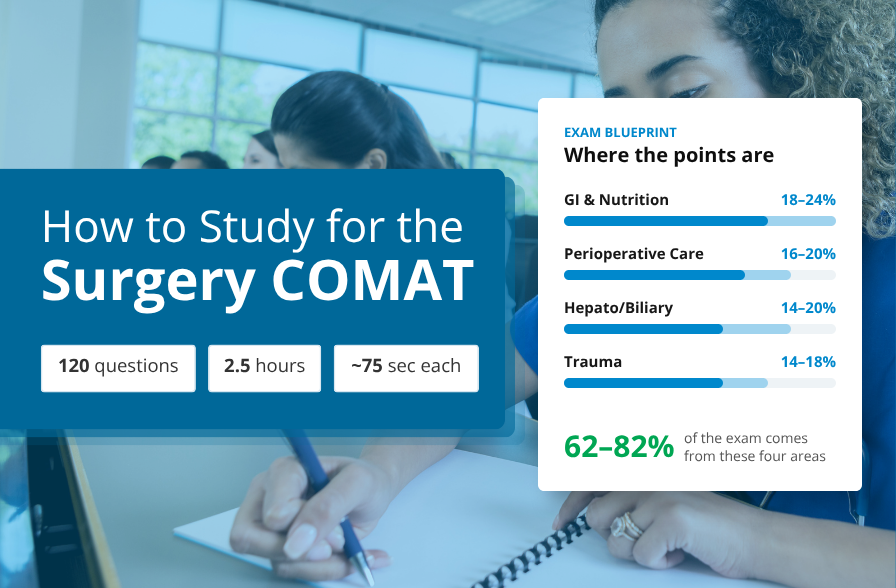
The Surgery COMAT is one of the NBOME’s eight COMAT Clinical Subject exams. Like the others, it has 120 questions to complete in 2.5 hours, which works out to about 75 seconds per question. OPP and OMM content is woven into the discipline questions rather than tested separately.
The NBOME’s Surgery blueprint sorts questions along two dimensions.
Dimension 1: Patient and Clinical Presentations
| Topic | Share of exam | Examples from the blueprint |
|---|---|---|
| GI System and Nutritional Health | 18–24% | Appendix, esophagus, stomach, small and large bowel, rectum |
| Perioperative Care | 16–20% | Airway and anesthesia complications, postop complications, fluids |
| Hepato/Biliary | 14–20% | Biliary tract, liver, pancreas, spleen |
| Trauma | 14–18% | Fluid and blood replacement, chest and abdominal injuries, fractures, transfusion reactions, FAST exams |
| Hernias | 9–12% | Inguinal, femoral, umbilical, incarcerated |
| Breast | 7–11% | Benign masses and cysts, breast cancer, gynecomastia |
| Endocrine System | 6–10% | Thyroid, parathyroid, adrenal, pituitary |
| Integumentary and Musculoskeletal Systems | 6–10% | Somatic dysfunction, skin and subcutaneous tissue, viscerosomatic relationships |
Together, GI, hepatobiliary, perioperative care, and trauma make up 62–82% of the exam. That’s where most of your study time should go.
Dimension 2: Physician Tasks
- History and physical, including diagnosis: 25–35%
- Diagnostic technologies: 25–35%
- Management: 25–35%
- Scientific mechanisms of disease: 10–15%
The even split across diagnosis, workup, and management means you need to know the full path for each condition: how it presents, which test confirms it, and what comes next.
How to Study for the Surgery COMAT
Think like the medicine team on a surgical patient
The Surgery COMAT rewards decision-making over technique. For each condition you study, ask four questions:
- Is this a surgical problem or a medical one?
- Is the patient stable, and if not, what do I do first?
- What’s the best next diagnostic step?
- What complications should I expect after surgery, and when?
If you can answer those for appendicitis, cholecystitis, small bowel obstruction, diverticulitis, and an incarcerated hernia, you’ve covered a large share of the exam.
Make perioperative care a priority
At 16–20% of the exam, perioperative care can give you easy points if you prepare but be costly if you don’t. Know maintenance fluids and electrolyte replacement, how to evaluate postoperative fever by day, and how to recognize and treat complications such as atelectasis, wound infection, DVT, PE, and anastomotic leak. Review preoperative risk assessment and prophylaxis too.
Know your trauma algorithm cold
Trauma questions follow a predictable order: airway, breathing, circulation, disability, exposure. Practice deciding the next step for an unstable patient, when a FAST exam or CT fits, and how to manage hemorrhage with fluids and blood products. If the patient is unstable, the answer is rarely “get more imaging.”
Don’t skip the osteopathic content
The blueprint lists somatic dysfunction and viscerosomatic relationships directly, and OMM findings often appear in question stems. Review viscerosomatic reflex levels for abdominal organs and when OMT is appropriate for surgical patients, such as for postoperative ileus. If OMM feels rusty, our OMM COMAT study guide is a fast refresher.
Practice at test-day pace
With about 75 seconds per question, pacing matters. Do most of your question blocks in timed mode, and use tutor mode early on or when you’re learning a new topic.
A Sample Study Plan for Your Surgery Rotation
This plan assumes a 6-week rotation with the COMAT at the end. Compress or stretch it to fit your schedule.
| Weeks | Focus | Daily target |
|---|---|---|
| 1–2 | GI and hepatobiliary, the two largest categories | 8-10 practice questions, with a review of every explanation |
| 3–4 | Perioperative care, trauma, hernias, and integumentary/MSK | 8-10 questions, with mixed blocks starting in week 4 |
| 5 | Breast, endocrine, and OMM integration | 10-15questions in timed blocks, plus a review of all missed questions |
| 6 | Weak areas and timed | Timed, mixed blocks across all categories early in the week, then a second pass on missed and flagged questions |
Tie your reading to your cases when you can. Reading about a gallbladder the night after you scrub on a cholecystectomy makes it stick far better than reading in the abstract.
Best Resources for the Surgery COMAT
Keep your resource list short. One reference text, one COMAT-specific question bank, and the NBOME’s own practice materials are enough for most students, plus an OMM text if you need a refresher.
- A COMAT-specific question bank. COMQUEST’s Surgery COMAT question bank has 335+ physician-authored questions and is updated regularly. Questions focus on what the exam actually tests: when surgery is indicated, how to stabilize patients, and pre- and postoperative management. The explanations walk through why each answer is right or wrong, so you build the reasoning, not just the recall.
- NBOME sample questions and COMAT-SE. The NBOME’s free Surgery sample questions show you the testing interface. COMAT Self-Evaluation (COMAT-SE) is a paid, 60-question practice form.
- One surgery reference. The NBOME lists Essentials of General Surgery and Surgical Specialties (Lawrence, 7th edition) among its resources. It’s a manageable read for a rotation, unlike larger texts such as Sabiston or Schwartz, which work better as references.
- An osteopathic text for OMM review. The NBOME also lists Foundations of Osteopathic Medicine and An Osteopathic Approach to Diagnosis and Treatment for OPP content.
Surgery COMAT FAQs
How many questions are on the Surgery COMAT?
The Surgery COMAT has 120 questions, and you have 2.5 hours to finish.
Is the Surgery COMAT hard?
Many students find it challenging because it tests more medicine than they expect. If you study surgical decision-making, perioperative care, and trauma management instead of operative technique, it becomes much more predictable.
Is there OMM on the Surgery COMAT?
Yes. The NBOME integrates OPP and OMM into every COMAT Clinical Subject exam. On Surgery, expect somatic dysfunction, viscerosomatic relationships, and OMM findings within clinical question stems.
How long should I study for the Surgery COMAT?
Most students study across their whole surgery rotation, usually 4 to 8 weeks. Steady daily question practice beats cramming in the final week.
Can I use NBME surgery shelf resources for the COMAT?
They help with core surgical content, but they won’t prepare you for the osteopathic content or the NBOME’s question style. Pair them with a COMAT-specific question bank.
Walk Into Your Surgery COMAT Ready
Practice the way the exam tests with COMQUEST’s Surgery COMAT question bank: 335+ physician-written questions focused on surgical decision-making, perioperative care, and trauma. Start practicing with COMQUEST.