
Most students find the Psychiatry COMAT feels manageable — right up until they’re in the middle of it and suddenly can’t remember whether a patient needs two weeks of symptoms or four to meet criteria, or whether the vignette in front of them is adjustment disorder or MDD. The content isn’t esoteric. The precision is.
This Psychiatry COMAT study guide targets that exact challenge: the high-yield content areas, the DSM-5 details that actually separate right answers from close-but-wrong ones, and how to build the kind of pattern recognition that holds up under exam conditions.
What Is the Psychiatry COMAT? Format and What to Expect
The Psychiatry COMAT comprises 120 questions administered over 2.5 hours, offered through the NBOME during your psychiatry clerkship. Like the other COMAT shelf exams, it’s vignette-based — but the psych COMAT has a few features worth knowing going in.
First, the exam uses DSM-5 criteria exclusively. If your preclinical materials were built on DSM-IV or older resources, some of the differences matter on test day.
Second, the exam assesses two core competencies: diagnosing psychiatric conditions accurately and selecting the appropriate treatment, both pharmacologic and non-pharmacologic.
Third — and this is the one that surprises students — normal vs. abnormal distinctions are frequently tested. Not every grieving patient has MDD, and not every anxious patient has an anxiety disorder. The exam regularly presents patients in difficult circumstances and asks whether they have a diagnosis or are having a normal human response.
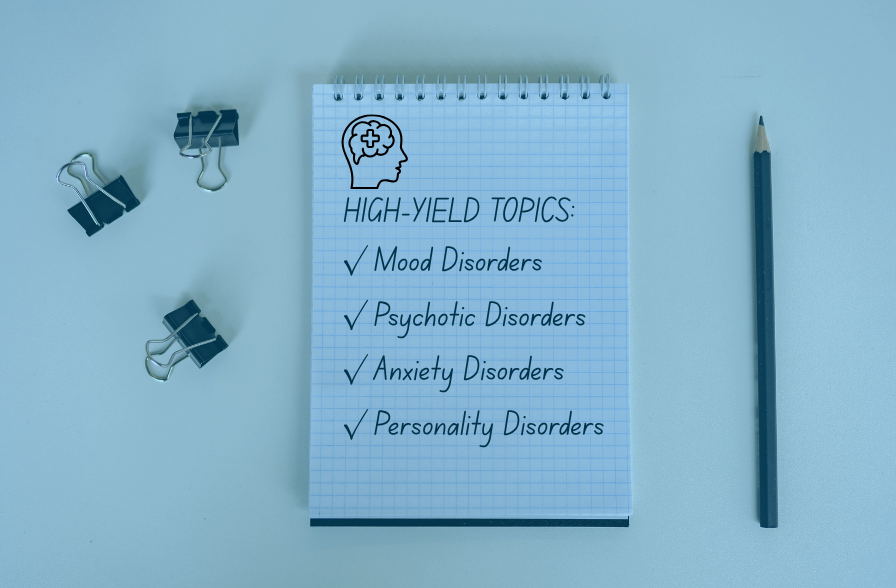
Psychiatry COMAT High-Yield Topics
Mood Disorders
- Major depressive disorder: 5 of 9 SIGECAPS criteria for at least 2 weeks, and one of them must be depressed mood or anhedonia
- Persistent depressive disorder (dysthymia): 2-year duration in adults — overlapping with MDD but distinct
- Bipolar I vs. Bipolar II: mania requires 7 days (or any duration if hospitalization is needed); hypomania requires 4 days. Know which episode type defines which diagnosis.
- Premenstrual dysphoric disorder: timing relative to the menstrual cycle is the giveaway in vignettes
Psychotic Disorders
- Schizophrenia: 6 months total duration with at least 1 month of active symptoms; two or more of the five positive symptoms
- Schizophreniform disorder: the same symptom picture as schizophrenia, but lasting 1–6 months
- Brief psychotic disorder: less than 1 month, often triggered by a stressor
- Schizoaffective disorder: know how to separate it from schizophrenia when a mood episode enters the picture
Anxiety and Related Disorders
- GAD: 6 months of excessive worry plus 3 of 6 somatic symptoms
- Panic disorder vs. panic attack: one is a diagnosis, one is a symptom — vignettes exploit this
- PTSD vs. acute stress disorder: timing again. ASD runs 3 days to 1 month after trauma; PTSD is beyond 1 month.
- OCD: obsessions and compulsions with an ego-dystonic quality
Personality Disorders
Know the key distinguishing features of Clusters A, B, and C, then go deeper on the individual disorders the exam favors: borderline (frantic efforts to avoid abandonment, identity disturbance), antisocial (requires evidence of conduct disorder before age 15), and narcissistic (grandiosity, as opposed to borderline’s instability).
Normal vs. Abnormal: The Trickiest Distinctions
- Grief vs. MDD: uncomplicated bereavement is normal, fluctuating, and tied to the loss. MDD is pervasive, anhedonic, and persistent beyond the expected timeframe.
- Adjustment disorder: an emotional response disproportionate to a stressor that doesn’t meet criteria for another disorder, and that resolves within 6 months of the stressor ending.
These distinctions matter because the exam is testing clinical judgment, not just recall — and students who reflexively pathologize every presentation give away points here.
Pharmacology You Need to Know Cold
- First-line treatments: SSRIs for depression and anxiety disorders; mood stabilizers for bipolar disorder (lithium, valproate, lamotrigine); antipsychotics for schizophrenia, including when to reach for typical vs. atypical agents
- Non-pharmacologic treatment: CBT as first-line for certain anxiety disorders, DBT for borderline personality disorder, ECT for severe refractory depression, and TMS as a newer option
- Side effect profiles the exam loves: lithium toxicity signs, serotonin syndrome vs. neuroleptic malignant syndrome, SSRI discontinuation syndrome, and the metabolic effects of atypical antipsychotics
- Suicide risk assessment: when to hospitalize vs. manage as an outpatient, protective vs. risk factors — the exam tests both identification and management
The DSM-5 Timing Criteria That Make or Break Psych COMAT Questions
If there’s one concept that costs students the most points on the Psychiatry COMAT, it’s time-based criteria. Two vignettes can be nearly identical, and the duration of symptoms is the only detail separating the right answer from the wrong one. Keep this table close in your final week:
| Diagnosis | Key Duration |
|---|---|
| MDD | 2 weeks |
| Persistent Depressive Disorder | 2 years (adults) |
| Bipolar I — Mania | 7 days (or any duration if hospitalized) |
| Bipolar II — Hypomania | 4 days |
| Schizophrenia | 6 months total (1 month active) |
| Schizophreniform | 1–6 months |
| Brief Psychotic Disorder | Less than 1 month |
| GAD | 6 months |
| Acute Stress Disorder | 3 days to 1 month post-trauma |
| PTSD | More than 1 month post-trauma |
| Adjustment Disorder | Within 3 months of stressor; resolves within 6 months of stressor ending |
When you’re reading a vignette, train yourself to circle the timeline first. It’s often the entire question.
How to Use COMQUEST to Study for the Psychiatry COMAT
COMQUEST’s Psychiatry COMAT question bank has over 380 questions written by board-certified physicians, updated continuously, and built around DSM-5. Where DSM-IV vs. DSM-5 differences matter, the explanations call them out — especially useful if your preclinical courses used older materials.
The most effective approach:
- Work through the bank by diagnostic category — mood disorders, then psychotic disorders, then anxiety disorders — so the criteria for similar diagnoses stay distinct in your head
- Read every explanation for its DSM-5 reasoning, not just the answer. The rationale is where the exam-level precision gets built.
- In the final days, focus on the normal vs. abnormal questions and the timing-based differentials — these are where students most often leave points on the table
The Psychiatry COMAT is one of the more learnable shelf exams. The diagnoses are finite, the criteria are objective, and the traps are predictable. Build the precision, and the exam takes care of itself.
COMQUEST’s Psychiatry COMAT question bank has 380+ physician-written questions built around DSM-5 — including the timing criteria and normal vs. abnormal distinctions that make the biggest difference on test day. Start practicing now.